
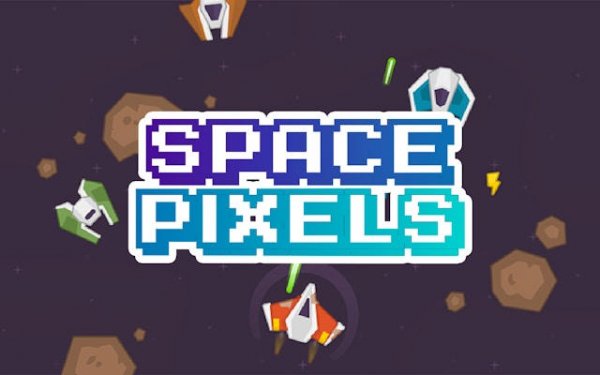
Pixel Art Presentation and Mood
Each galaxy in Stellar Pixel Navigator uses its own color palette and background pattern, so moving between them feels like entering a distinct region rather than a recolored version of the same map. Animated starfields and softly glowing planets keep the backdrop lively without competing with the foreground. Ships carry subtle movement animations, and collectible items shimmer gently, which helps them stand out during fast play. The art style stays readable at speed, a practical choice that supports the arcade format rather than just a nostalgic flourish.
Handling and Moment-to-Moment Play
You steer your ship with directional inputs, and the handling is tuned to feel responsive. The physics model gives the ship a slight momentum, so cornering and braking require small anticipatory adjustments. That single design decision separates Stellar Pixel Navigator from arcade games where the ship stops the instant you release the controls. Asteroid fields and cosmic debris form the main obstacles, and new environmental elements appear gradually, including moving barriers and temporary speed boosts. Each level has its own layout of pathways and collectible placements, which encourages repeated attempts to find cleaner routes and gather everything available.
Progression and Ship Customization
Completing objectives earns experience points that feed into a commander profile. That profile unlocks new ship designs and cosmetic options. Ships differ in appearance and handling characteristics, so the choice affects how the game feels, not just how it looks. A hangar lets you view and equip collected ships between runs. The system rewards consistent play without demanding long sessions, and regular updates add ship types and visual themes over time.
Modes, Difficulty, and Family-Friendly Design
Multiple game modes change the pace and the goal. Some modes focus on collecting gems efficiently within a time limit, while others ask you to reach a destination without colliding with obstacles. Each mode has its own levels, and complexity increases as new obstacle types and layout patterns are introduced. Seasonal events offer limited-time levels with exclusive rewards. The difficulty curve stays gentle, and failure only means restarting a level, which keeps frustration low for younger players. Controls work on touchscreens and traditional input methods, and the upbeat music and sound effects are designed to stay in the background.






Editorial Notes