
Curved Punch Mechanics
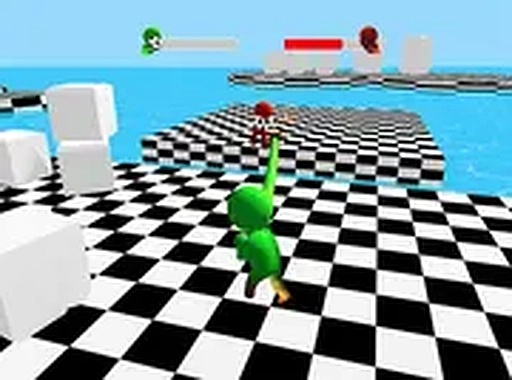
Combat in Flexible Fighter Tactical Brawl revolves around a single unusual action: instead of throwing direct punches, you draw a curved path for your fighter's elongating arm. The arm bends around walls, under ceilings, and over barriers, so every strike is a plotted trajectory rather than a reflex. The physics engine calculates the path, giving each hit a sense of weight and responsiveness. Because the arm follows your drawn line, accuracy depends on how well you read the arena and predict where your opponent will be when the punch lands. This turns each exchange into a small spatial puzzle.
Arena Obstacles as Tactical Tools
Arenas are built from platforms, pillars, and low barriers that block direct lines of attack. A tall central pillar might hide your opponent completely, forcing you to curve a punch around its side. Low walls encourage high, arcing strikes that drop onto a target from above. These structures are not background decoration; they define which trajectories are possible and which are wasted. Adapting to each layout means finding new angles rather than repeating a single reliable punch. The variety pushes players to experiment with different curves and speeds instead of settling into one pattern.
Controls and Match Flow
Using a mouse or touchscreen, you click and drag to sketch the intended path of your punch, then release to launch it. The interface stays clean, so the basic action is easy to understand. Rounds last only a few minutes, and each fighter has a health bar that drops with every successful hit. The goal is to reduce your opponent's health to zero first. Because attacks take time to travel along their curve, matches become a back-and-forth of dodging incoming paths while setting up your own. There is little downtime, and reading your opponent's habits matters as much as aiming well.
Skill Development and Strategic Depth
Improvement comes from timing, prediction, and creative trajectory planning. A poorly aimed punch leaves you exposed, so patience often beats aggression. As you learn how different angles affect reach and accuracy, you begin to favor certain curves or setups, gradually developing a personal style. The game rewards observation over luck, and victories tend to feel earned through smart positioning rather than fast reflexes. This makes it approachable for newcomers but still demanding for players who want to master the curved-punch system.







Editorial Notes